How To Interpret A Fecal Egg Count: Looking Beyond The Number
You ran a fecal egg count on your animal and now you have a number.
So...what do you actually do with it?
It’s a question I hear often from livestock owners learning to perform their own fecal egg counts.
Maybe your result is 100 eggs per gram. Maybe it’s 600. Maybe it’s much higher.
It can be tempting to look at that number and immediately ask:
“Is this high? What should I do?”
But a fecal egg count (FEC) is just one piece of the puzzle.
Before deciding what a result means for an individual animal, I like to take a step back and look at the bigger picture.
WHAT DOES A FECAL EGG COUNT ACTUALLY TELL US?
A fecal egg count measures the number of parasite eggs being shed in the feces and reports the result as eggs per gram, or EPG.
That gives us valuable information about the parasite infection at the time the sample was collected.
But the number needs context.
It's also important to consider which parasite eggs are present. For example, a result reported as strongyle in a goat doesn't automatically mean Haemonchus contortus, or barber pole worm. Several gastrointestinal nematodes produce strongyle-type eggs that can be difficult to distinguish from one another during a routine fecal examination.
Understanding what the test is actually telling us is the first step toward interpreting the result.
START WITH THE ANIMAL
Before I focus too heavily on the number, I look at the individual animal.
How is it acting?
Is it eating normally?
What is its body condition?
Is there diarrhea?
Are there other clinical signs that suggest something may be going on?
Depending on the animal and parasites of concern, additional tools such as FAMACHA scoring may provide useful information as well.
The goal isn't to ignore the fecal egg count. It's to interpret that number alongside the animal standing in front of you.
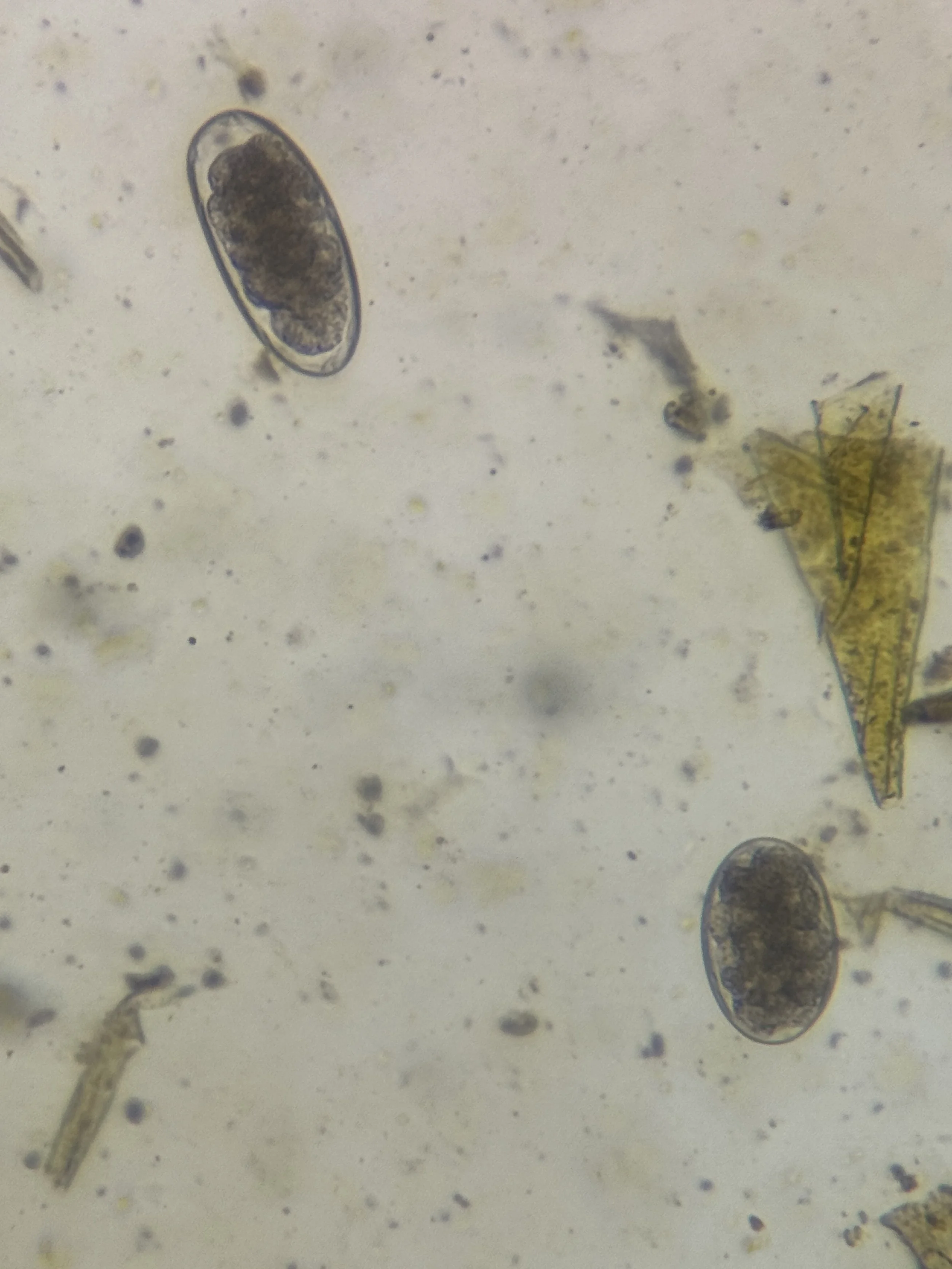
Strongyle-type egg observed during fecal examination.
NOT EVERY ANIMAL RESPONDS THE SAME WAY
This is another important piece of FEC interpretation.
Individual animals can vary in their susceptibility and immune response to parasite infection.
Age and life stage matter. Previous parasite exposure can matter. An animal's history of fecal egg counts and previous treatments can provide additional context.
Two animals can be exposed to the same environment and still have very different parasite patterns.
This is also why looking at fecal egg counts over time can be so useful. Instead of relying on a single snapshot, repeated testing can help you begin to understand what's typical or atypical for an individual animal.
WHAT ELSE DO WE KNOW?
Once I have the FEC result and have looked at the animal, I start putting the rest of the pieces together.
I might ask:
What species and age is the animal?
What parasite eggs were identified?
What have previous fecal egg counts looked like?
When was the animal last treated?
What are the other animals in the herd experiencing?
What is happening environmentally or seasonally?
Have there been any recent management changes?
There may be other questions depending on the situation, but each piece of information helps build a more complete picture.
THERE ISN'T ONE MAGIC NUMBER
This is probably one of the most important concepts when learning to use fecal egg counts.
The goal isn't to find one universal number that tells you exactly what to do in every situation.
Instead, the fecal egg count becomes one piece of information that you combine with the animal, its history, clinical signs, management, and other relevant factors.
Depending on the situation, next steps might include continued monitoring, management changes, further investigation, treatment considerations, or consulting with your veterinarian.
The more information you have, the better equipped you are to decide what your next step should be.
THINK OF IT AS A PUZZLE
One of the things I enjoy most about parasite diagnostics is that there's rarely a single piece of information that gives us the whole answer.
A fecal egg count gives us an incredibly useful piece of that puzzle.
The key is knowing how to put it together with everything else we know about the animal.
So the next time you get an FEC result, instead of immediately asking:
“Is this number high or low?”
Try asking:
“What does this result tell me, and what else do I need to know?”
That shift can help you get much more useful information out of your fecal egg counts.
WATCH THE VIDEO
In my latest YouTube video, I walk through this process using a two-year-old goat with a strongyle fecal egg count as an example.
We look at what the result tells us, what additional information I would want to know, and why the number alone doesn't necessarily give us the whole answer.
🎥 Watch: How to Interpret a Fecal Egg Count | Goat Parasite Case Study
WANT TO LEARN TO PERFORM YOUR OWN FECAL EGG COUNTS?
Farmer Analytics' DIY Fecal Egg Counting courses teach livestock and horse owners how to perform fecal egg counts at home, from preparing samples and using a microscope to identifying parasite eggs and understanding their results.
Registration is now available for the next Ruminant course in February 2027 and Equine course in March 2027. If you'd like to take both, a Ruminant + Equine Bundle is also available.
LEARN MORE ABOUT DIY FECAL EGG COUNTING COURSES
This article is for educational purposes only and is not intended to provide veterinary diagnosis or treatment recommendations. Fecal egg count results should be interpreted alongside the individual animal's health and history. Consult your veterinarian for diagnosis and treatment recommendations specific to your animals.