The Best Microscope for DIY Livestock Fecal Egg Counting (My Recommendation)
One of the most common questions I receive is:
"Which microscope should I buy?"
If you're shopping for your first microscope, the number of options can feel overwhelming. Fortunately, you don't need an expensive laboratory microscope to perform accurate livestock fecal egg counts at home.
After teaching more than 100 livestock owners how to perform fecal egg counts, my recommendation has remained the same: the AmScope B120 Series.
It includes the features needed to perform accurate fecal egg counts without paying for features you simply don't need.
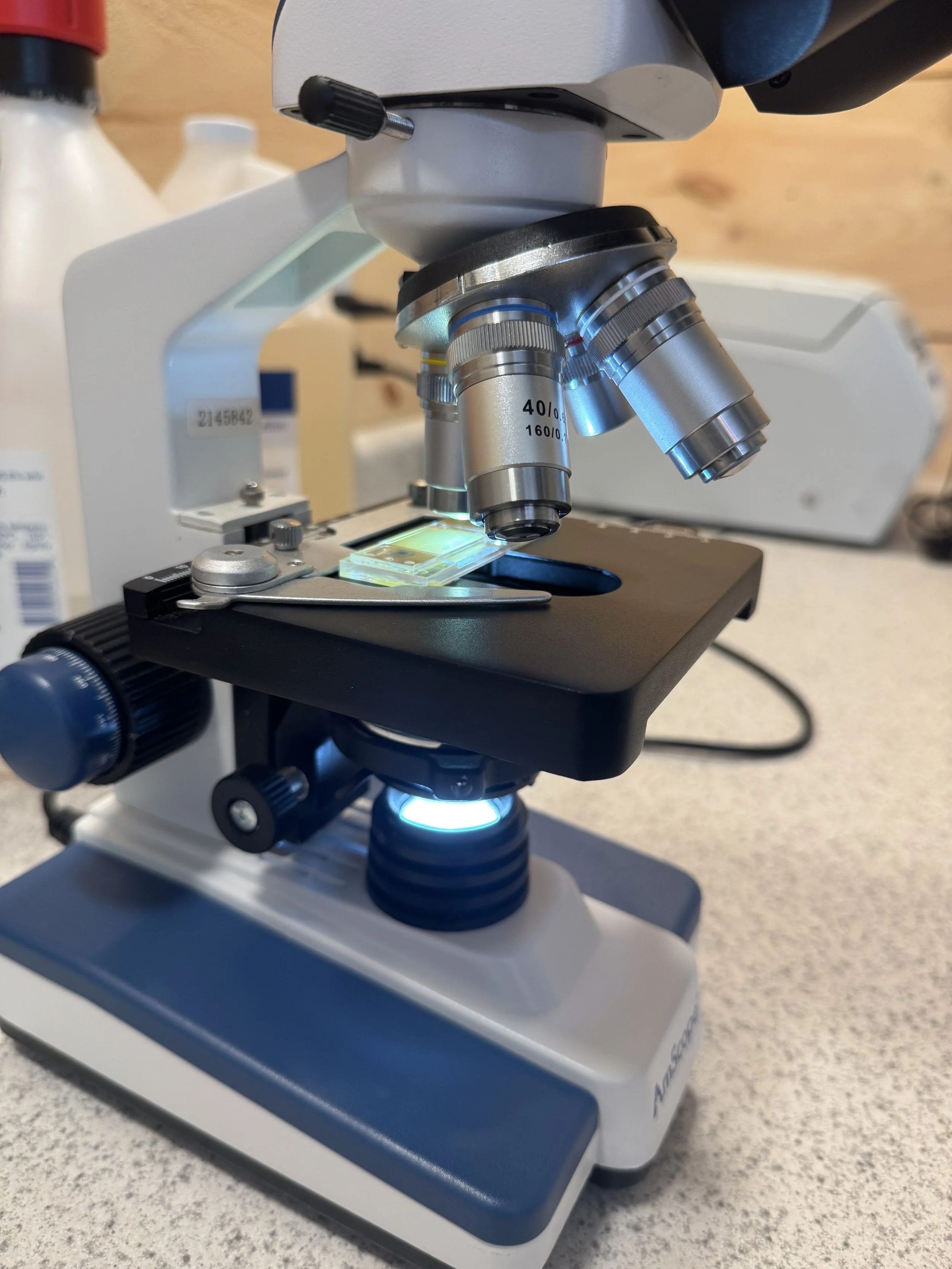
The AmScope B120 Series microscope that I recommend for routine livestock fecal egg counting.
Features I Recommend
When choosing a microscope for fecal egg counting, these are the features I recommend looking for:
Compound microscope
Provides the magnification and optical quality needed to accurately view parasite eggs and other microscopic structures.
LED internal light source
Provides bright, consistent illumination with very little maintenance.
Mechanical (moveable) stage
Allows precise slide movement while reading a McMaster chamber, making counting easier and more accurate than moving the slide by hand.
4× and 10× objective lenses
These are the objective lenses used for routine fecal egg counting. Most compound microscopes, including the AmScope B120 Series, also include a 40× objective. While the 40× objective can occasionally be useful for taking a closer look at a structure, routine fecal egg counting is typically performed using the 4× and 10× objectives.
Coarse and fine focus knobs
Both are important for bringing the sample into focus and fine-tuning the image to distinguish parasite eggs from debris and artifacts.
Monocular or binocular?
Either style works well for fecal egg counting. Binocular microscopes are generally more comfortable during longer sessions, while monocular models are often a little less expensive.
Together, these features provide everything needed for routine fecal egg counting without paying for unnecessary extras.
Features You Can Skip
When shopping for microscopes, it's easy to assume that more features automatically mean a better microscope. For routine livestock fecal egg counting, that's simply not the case.
You can usually save yourself a significant amount of money by skipping features that aren't necessary for this application.
100× oil immersion objective
Designed for applications requiring very high magnification and not needed for routine fecal egg counting.
Trinocular head
Useful if you plan to permanently attach a camera, but unnecessary for most livestock owners.
High-end research optics
Excellent for advanced laboratory applications, but not required for routine fecal egg counting.
Premium laboratory microscope
A quality entry-level compound microscope performs very well for this application without the added expense.
Eyepiece camera or display screen
Nice to have if you want to capture images or share your view with others, but certainly not required. Many people take excellent microscope photos using a smartphone, and inexpensive phone adapters are also available if you prefer a more stable setup.
By focusing on the features that actually matter, you can invest in a microscope that performs well without paying for accessories and upgrades you may never use.
Why I Recommend the AmScope B120 Series
After teaching fecal egg counting courses to more than 100 livestock owners, the AmScope B120 Series remains the microscope I recommend most often. It consistently provides an excellent balance of quality, functionality, and affordability for routine fecal egg counting.
The B120 Series checks all of the boxes I recommend:
Compound microscope
Bright LED internal light source
Mechanical stage
Coarse and fine focus knobs
4×, 10×, and 40× objective lenses
It produces a clear image, is straightforward to use, and provides plenty of room to grow as your microscopy skills improve. Whether you're testing sheep, goats, horses, cattle, or other livestock, this microscope has everything needed to perform routine fecal egg counts with confidence.
If you'd like to see the microscope I use and why I recommend it, be sure to watch my YouTube video on choosing your first microscope.
My Recommended Microscope
I typically recommend the AmScope B120 Series for students learning fecal egg counting. It is available in several configurations, including models with and without a camera. The model linked below includes a camera, but a camera is not necessary for routine fecal egg counting. If you choose a different model, simply make sure it includes the features discussed above.
→ View the AmScope B120 Series on Amazon(affiliate link)
A Few Final Thoughts
Choosing the right microscope is an important first step, but it's only one part of performing accurate fecal egg counts. Proper sample preparation, slide loading, focusing technique, parasite identification, and result interpretation are equally important.
If you'd like to learn the complete process, my live online DIY Fecal Egg Counting courses walk students through each step, from collecting a sample to confidently performing and interpreting fecal egg counts on your own farm.
Learn more:
Thank you for reading, and I hope this helps you choose a microscope with confidence.
Still have questions about choosing a microscope? Feel free to contact me. I'm always happy to point people toward a microscope that fits their needs and budget.
Disclosure: This article contains affiliate links. If you purchase through these links, I may earn a small commission at no additional cost to you. I only recommend products that I personally use or would confidently recommend to my own students.